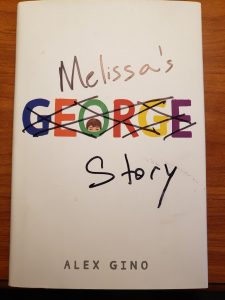
The author’s copy. Reader fixes below.
Edit Oct. 28 2021: Hurray! My publisher, Scholastic, is officially changing the title to Melissa! Read more about the change in this Publisher’s Weekly article as well as my thoughts at the On Our Minds Scholastic blog. And download a new printable cover here or fill out this form for a sticker. You can also still, of course, engage in #SharpieActivism and fix your own cover.
I made a mistake when I named my first published middle grade novel. A big mistake. I used a name for my main character that she doesn’t like for herself (i.e. George, the title of the book) instead of her actual name. My main character’s name is Melissa, and I apologize to her, to the larger trans community, and to all of my readers for the error. I’m sorry.
She is not real, so I can’t hurt her feelings, but the title of my book makes it seem as though it is ever okay to use an old name for a person when they have provided you with a different name that works better for them. I want to be clear – it isn’t.
I know. The cover is beautiful. Iconic, even. But here’s the thing: so many transgender people have been told that we are beautiful/handsome as a reason not to transition, myself included. We are told that we will mar something special, as though looking pleasant to others is more important than being ourselves. As if it’s not more important than seeing who’s really there, scars and all.
Within the story, I think the disconnect between the name George and the pronoun she is a valuable literary technique and reflects the tension many trans people feel, especially before coming out to others. There’s a purpose to it, though it’s still a questionable choice for an omniscient narrator. But on the cover? It is an unequivocal error. Using a person’s name is a basic form of respect, and I failed my main character.
There are literally tens of thousands of people who have heard of my book but haven’t read it, and for whom George is the only name they have for Melissa. People who have gotten yet another cue, this time from a nonbinary writer who advocates for LGBTQIAP+ youth of all places, that a trans girl “starts out as a boy”.
And yes, I know, there are a few women named George and Georgie out there, (looking at you, Charlotte Ritchie’s character in Feel Good). But the quirkiness of the name for women works precisely because the name is coded male, and for Melissa, the name is a reminder of all of that coding. Hearing yourself called by the wrong name can feel invalidating. Hearing yourself called by a name associated with a painfully ill-fitting identity that has been thrust upon you? Yuck.
So, how did I make such a giant, bumbling error? Well, here’s the explanation. Not as an excuse, but for transparency and to give a little insight on how swiftly culture is shifting with respect to trans youth. As I was writing, I jokingly called my manuscript Girl George. You see, there was a flamboyant singer from the 80s named Boy George, and my title was a play on that. But not only is that not actually very funny, it also doesn’t fit my kid/pre-teen demographic.
When I sold the book, my publisher advised that we take the word girl off the cover. And while many of the details of that time are lost to a flurry of excitement and disbelief, I remember that moment, and how the idea raised the hairs on my feminist neck. You’re going to do what to the word girl? But then my editor pointed out that the word girl was a barrier to access because there would be some people who wouldn’t give the book to a boy if it had the word girl on it. Note that the concern wasn’t just that boys would self-censor, but that adult gatekeepers wouldn’t give boys a chance to make that decision in the first place. Aha, I thought, sneaky feminism. My favorite!
I didn’t really think about it much after that. I was still pretty stunned that my book was going to be published at all, and didn’t quite understand where my creative rights as an author ended and the sales goals of the publisher began. To be honest, I still don’t, but then, I didn’t even know to push. I was too swept up in being surprised and grateful to recognize my responsibility.
It’s also worth mentioning the rapid shift in much of culture with respect to trans people, especially trans/gender non-conforming youth. I started writing Melissa’s Story in 2003, back when the idea that a trans kid would be listened to and allowed to be themselves was mostly an impossible dream for most of us. The concept of “deadnaming”, or calling a trans person by the name assigned at birth against their wishes, didn’t really come into existence until 2012. (Note that this term is itself questionable, since the idea of calling someone’s former name/identity “dead” isn’t actually all that great for all of us.) I made endless changes to the book to reflect changes in culture, but like missing the forest for the trees, I didn’t see the damage inherent in the title, whether or not “girl” was included.
I wish I had realized to speak up then, and I wish I could change it now. But it’s not mine to change anymore. Yes, publishers correct mistakes in new printings of books all the time. But when the mistake is the title, it’s harder to get the change made, especially if the book is successful.
So what do I do now? What do we do now? Well, maybe we’ll hit a cultural tipping point where the social outdatedness of calling a trans girl by her name assigned at birth makes the need for the change obvious. I’m not actually that hopeful of that, but also, I never expected to see gender-neutral bathrooms in elementary schools, and yet, here we are.
Which leads me to the tweet I made last week:
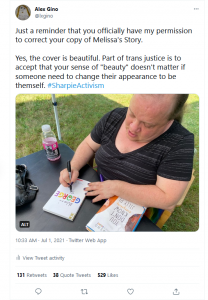 The picture is of me at a recent, outdoor event changing the cover of someone’s book before signing it. The text reads: “Just a reminder that you officially have my permission to correct your copy of Melissa’s Story. Yes, the cover is beautiful. Part of trans justice is to accept that your sense of “beauty” doesn’t matter if someone need to change their appearance to be themself. #SharpieActivism”
And that’s where I’m at now. I can’t change the system, but I can change my actions. I can’t change every cover, but I can change mine. And you can change yours too. (Note: I can only endorse fixing copies you own.)
So maybe part of the process of reading Melissa’s Story (for now, at least) is to get to the end and fix the title yourself. Call it interactive reading. Heck, when you give Melissa’s Story as a gift, include a permanent marker.
So fix your copy! Do it up! Creativity is queer! Share a photo of your cover on twitter with the hashtag #SharpieActivism. Other social media too, I guess, but I’m not on those. 🙂 Or email me at alex@alexgino.com with a photo and name you’d like me to use to share yours and I’ll post it here. [Note: the gallery is now closed to new entries.]
P.S. Librarian-type folks? The OCLC master has been edited so if you re-download, Melissa’s Story should appear as an alternative title.
READER FIXES!!
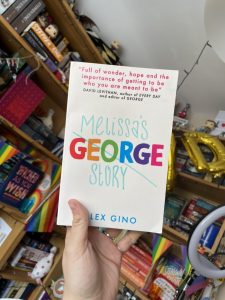
Look at Ren’s beautiful handwriting!
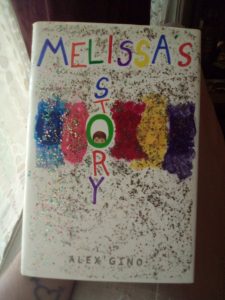
Adrien kept it understated.
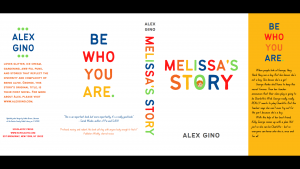
Check out this downloadable dust jacket by Ashlee Brown of the Kenton County Public Library!
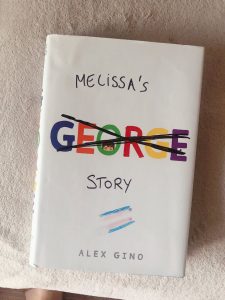
Jules included a flag motif!
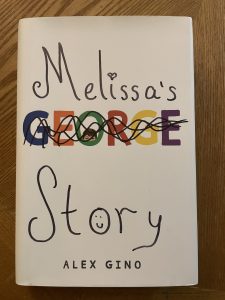
Nicki nailed the middle grade handwriting!
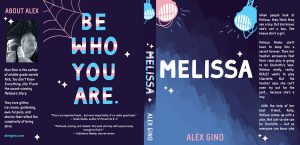
What a lovely dust jacket from Mars!
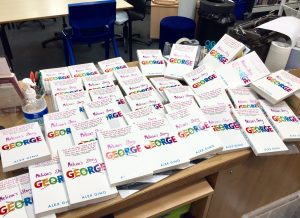
Jane Hill (@codenamejane) has taken it large scale for a class set!!
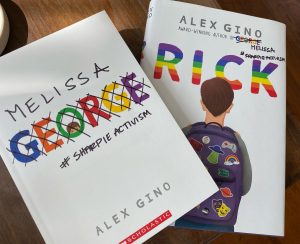
Heather Beztilny remembered to fix RICK as well!
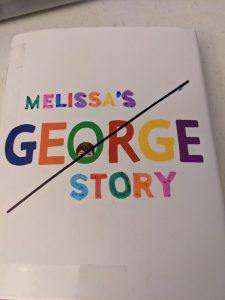
Check out this lettering work by family health librarian Emily P (@HealthLitLib)!
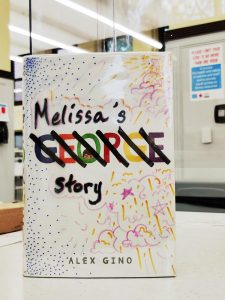
Jenny’s design style is super!
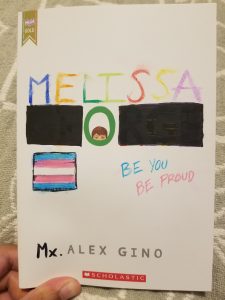
Ash (IG: @ashtheblackram) made sure to leave Melissa alone in her O for trans visibility.
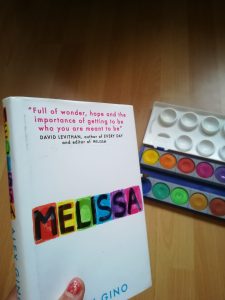
Cynna Moon (IG:@i.am.cynna.moon) brought out their paint set!
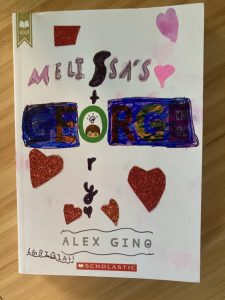
Sisters Layla and Julia collaborated on this sparkled up beauty!
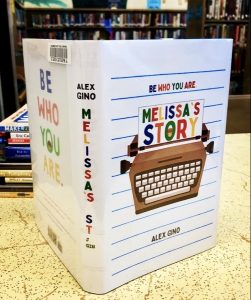
Check out what the Oakley Branch of Buncombe County Public Libraries in North Carolina!
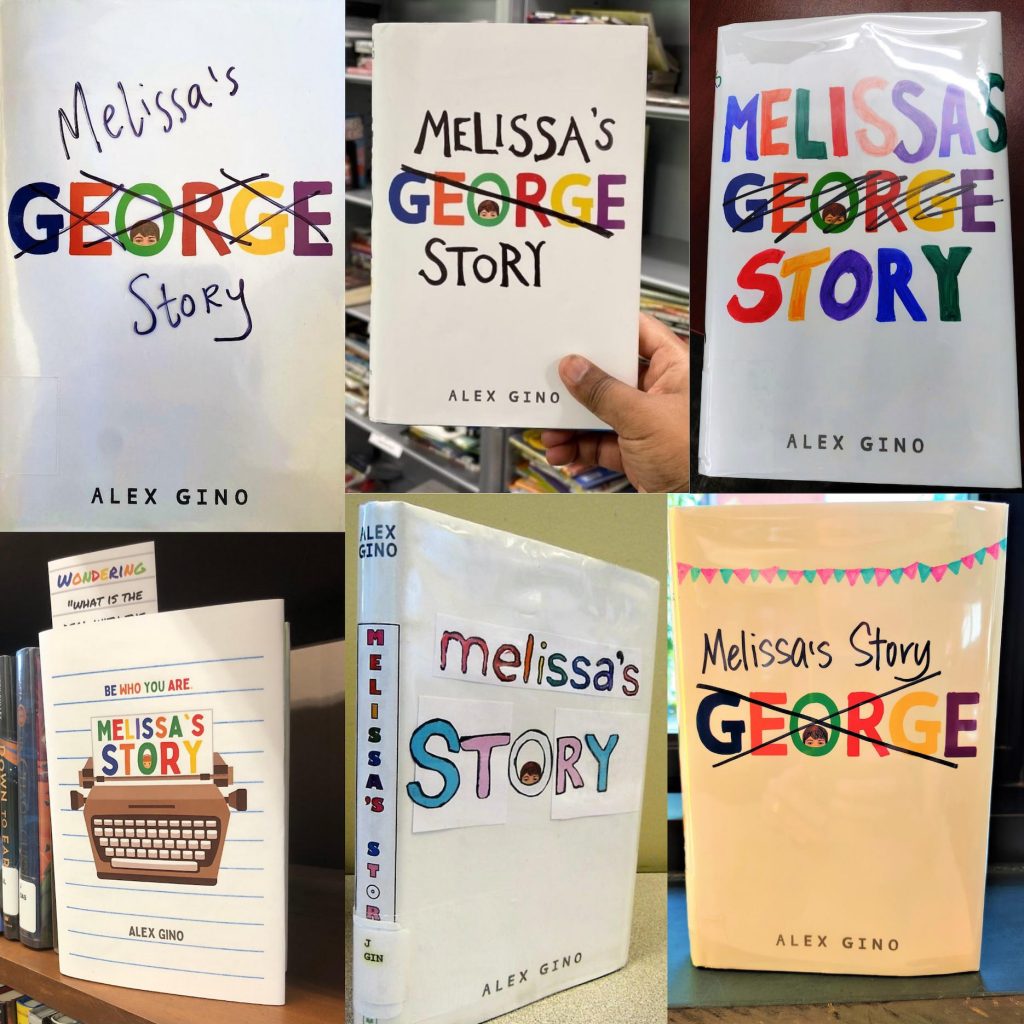
Not to be outdone, the other branches of Buncombe Public Libaries show off!
Thanks to all for your support. This gallery will no longer be updated, now that the title change is official!
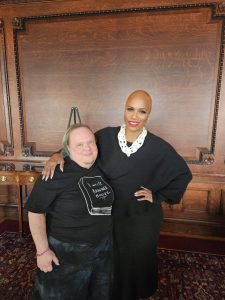 I had the honor of attending a roundtable on book banning convened by Congresswoman Ayanna Pressley in the Library of Congress! She is introducing #BooksSaveLives legislation and we met to talk about current issues in the field, messaging, etc.